ITIT MattersBrandyce.net

Latest posts

Notes on engineering, tooling, and whatever else is worth writing down.

Pete Lombardo

RestartOS

One of my personal projects for many years, restartOS, has seen some good active development lately, mostly for ARM based systems (think Raspberry Pi, Orange Pi, etc). The premise of it is that I take a Debian-based Linux distribution and I finess it so that it runs completely in memory. It is very similar to the way a live-boot ISO works, but with some key differences. The most important is that it’s not a pre-installation environment. It is a full OS intended to be used for whatever creative purposes you can find for it. Because it does allow for you to flag some files as being persistent, you can customize it as, say, a file server, and mount external storage as read/write and then every time your system reboots it will start up your file server for you. This is one of many use-cases. It can run containers (using Podman), which opens the door to running any number of services on it. But at the end of the day, the OS itself is non-persistent, meaning any changes made while it is...

Read More


Pete Lombardo

Tinnitus

Oh man, what a month. It started when I put on a hockey helmet that was too small and when I snapped the cage to behind my ears, the snap was so loud that it caused my hearing to go out in my right ear for a few seconds. When it came back, everything seemed fine. But later that night, when I was in a quiet room, I noticed my ear ringing — tinnitus. At first it didn’t phase me, I just figured after a few days it would go away. I also figured that I needed to stay away from loud sounds until it went away. But after a month passed, the ringing was even louder, and it had transitioned to both ears, not just one. So I went to an audiologist and was told that basically, the loud noises probably triggered a freak-out moment for my brain and that’s why my hearing went out momentarily, and when it came back, the baseline for my hearing was basically wrong. So instead of hearing normally, my brain was processing all the garbage signals that my ears were sending when there was no real noise in...

Read More
AGI Dangers
Pete Lombardo

AGI Dangers

Artificial General Intelligence, or AGI, has been the holy grail of AI for many years. With the ground-breaking advent of Large Language Models (LLMs), we took leaps forward toward that goal. Now with chain-of-thought prompting, reasoning and self-feedback are among the last hurdles that I would expect before we achieve AGI. So, as a bit of a thought experiment, I considered what life will be like once AGI arrives, and how it will change the way we function and what new vulnerabilities it may introduce. Imagine an AGI that is connected everywhere you go. It’s on your phone, it’s on your Amazon Echo, it’s ever-present. You type an email and think that the 7th is Tuesday, but it’s really Wednesday and the AGI picks up on it and fixes it for you. You ask it to remind your wife to pick up the kids and it knows how to reach her and what time the kids need to be picked up already. You get home and look at your doorbell camera and say, “Open the garage” and it does a voice and face analysis...

Read More
VMs are dead. Long live containers.
Pete Lombardo

VMs are dead. Long live containers.

In the early 2000’s, we were introduced to virtual machines promising the ability to layer multiple complex environments on top of the same hardware without interfering with one another. We graduated from single-purpose servers to multi-purpose servers, greatly improving efficiency and allowing data centers to outgrow their physical footprint in terms of traditional usefulness. Fast-forward to the present time and container technology, that has been around for decades as well, has matured to the point that most services that we would run on VMs can now run from containers. What’s the big deal? Well, at the end of the day, virtual machines emulate hardware and containers do not. This gives containers an edge over VMs regarding performance. But it goes deeper than that. VMs are generally big and bulky. Containers are generally small and modular. Container technology allows for faster backup and recovery times, tighter standardization (through compose yaml files), all in addition to the...

Read More
Boeing’s 737 Max Problem
Pete Lombardo

Boeing’s 737 Max Problem

To understand Boeing’s challenge, consider if you were to build a house with 2000 sq. ft. You spec an air conditioner and heater out for it and run all of the ducts and everything is perfectly working as designed. Now you want to add a room. So you add a 500 sq. ft. room. you split a nearby duct and feed the new room. But your HVAC system is not designed for 2500 sq. ft. and the ducts are not run from your HVAC unit directly to the new room. So now you have a consequence of having diminished the HVAC effectiveness in the existing areas, and also in the new area. To fix the problem, you develop fancy software to control electronic louvers that route air to where it’s needed so that you can prevent hot/cold spots. Now you’ve introduced something else that, if it breaks, can jeopardize the effectiveness of your entire HVAC system. At the end of the day, you have compromised the initial design in a way that can only truly be corrected with a completely new design. Anything but, just adds...

Read More
Container Wars – Podman vs. Docker
Pete Lombardo

Container Wars – Podman vs. Docker

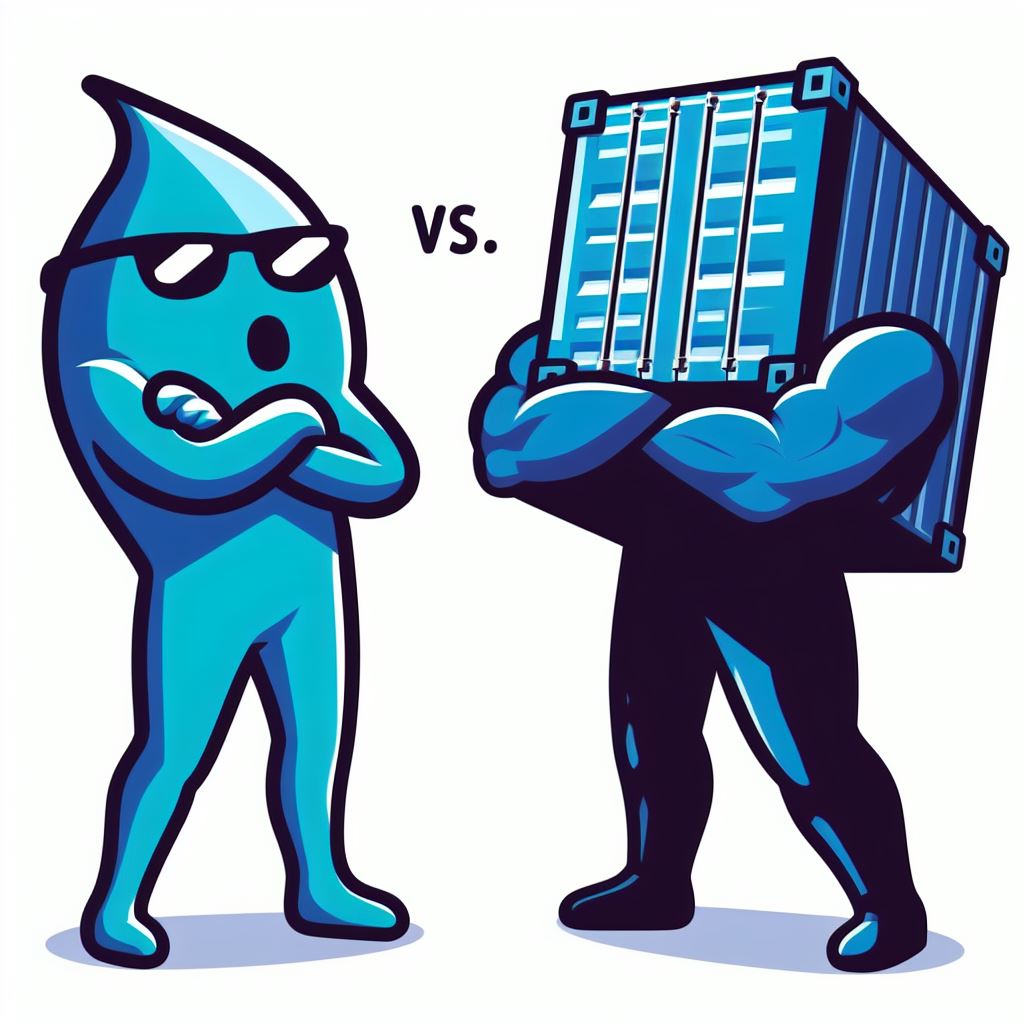
This article is intended for developers familiar with Docker and container management who are curious about trying Podman. I recently began a quest to test Podman to explore its features and assess its feasibility as a Docker replacement. The first thing I had to do was add the docker.io registry to podman so that I could basically use podman as a drop-in replacement to manage my docker-compose.yml files. Now, I wanted to use podman-compose, but quickly discovered that this application is still undergoing many bug fixes. Installing the apt version of podman-compose, for example, gave me version 1.0.3, but it was actually version 1.0.6+ that I needed in order to work past a bug that prevented one of my host-network containers from starting. As the apt version wasn’t suitable, I opted for a pip3 installation, which offered version 1.0.6+ (the newest version with less bugs). But when I ran it, I received the following. error: externally-managed-environment. So I tried this command –...

Read More
Pete Lombardo

GlusterFS Optimized for VMs (Ultra-Low-Cost)

This is a 4-node glusterfs cluster setup as a replica 3 arbiter 1 cluster. I use 512MB shards, reducing fragmentation of VM disks without hurting performance. My disks are all backed by SSDs. Every node has up to 2 bricks on 2 different disks. Every node is an Android TV H96 MAX X3 box running Armbian with disks attached via the USB 3.0 port. I am able to reboot any node without data loss. GlusterFS Volume Options And a custom sysctl.d config:

Pete Lombardo

Technology – Cost, Risk, and Reward

As a trusted decision maker in the technology space, I am constantly evaluating the following three things. Cost, risk, and reward. When choosing the right technology to solve a problem, not evaluating all three areas is, at best, wasteful – and at worst, exceedingly risky. Take for example the tried and true example of telephone service. What is the cost, risk, and reward profile of a standard copper-delivered (POTS) telephone service to a company? Well, the cost is relatively high, the risk is relatively low, and the reward is relatively low – it does what it’s supposed to do, and not more. But if we consider VoIP, now we have a lower cost, a higher risk (Internet issues may influence quality or availability), and higher reward (flexible vendor choice, mobility options, etc.). Risk typically increases as cost decreases for different solutions. If cost is the primary driver of a solution, then risk will likely be higher. When stability is the driving factor for a project or...

Read More
Pete Lombardo

Technology Matters

I recently had a candid conversation with one of our marketing executives, and I was shocked to learn her perspective on IT’s purpose within the company. The conversation was about web site performance. I was talking about how so many of the company’s objectives require IT, including her objectives to improve the web site’s performance. She had been working directly with our internal development team for over a year to get a project rolling to improve our web site’s performance with no traction and no success. Immediately after learning about her objective, I offered a solution. Since our developers were unable to prioritize a project for her, I suggested that we put a layer of caching in front of the site to meet her performance objectives without having our developers modify a single line of code. I explained to her how IT is entrenched in every aspect of the company, charged with the goal of making everyone more efficient and finding creative solutions to the company’s technical...

Read More
Load more posts